
caribtecture: Caribbean | The impact of the Haitian Revolution on Haiti’s Architecture: a discussion
- Bonita Alicia Bart

- Sep 12, 2024
- 12 min read
The Haitian Revolution was one of the most celebrated uprisings against colonialism in the world. Widely recognised as the first successful revolution launched by slaves, the event is viewed by many as a truce in an ongoing struggle between good and evil. Beginning on August, 22nd, 1791 a series of conflicts led to the overthrow of the French Regime in Haiti by Africans.
Writer’s Objective: This paper is an attempt to recapture and resuscitate part of that history by delving with some subtlety into Haitian architecture and exploring the impact of the Haitian Revolution on its development. Although the paper is limited in its approach and somewhat general in its conclusions, it is hoped that it will also be of interest to those seeking to understand Haiti's development as a country that was forced to grapple with its past in order to build a future.
A unique terra incognita to many in the West, Haiti has made few demands on the attention of the world, despite its potential for becoming a major player. Its history has slipped through the cracks of the world's collective memory. Haiti is not only a country on the western part of the island of Hispaniola, its geographical profile reads value. It is positioned on the shelf of the Caribbean known as the shelf of Cul de Sac. Located in the Caribbean Sea along with various islands including the Gonave, Tortuga, and Navassa Islands. One of the most interesting things about Haiti is that two-thirds of its land is mountainous. Despite this the island remains fairly cool regardless of the warm or hot sun. This is a major difference between the neighbouring island of Jamaica and Haiti. These mountains however have been scared, exploited for economic means, leading to deforestation. This deforestation is primarily due to the production of charcoal and wood burning for fuel used to cook the nation's food. It’s relationship with its neighbouring island Jamaica, remains strained. Due to tensions over migration and fears of an insure of human resources. Its bridge point would be the island of Navassa. This island lies about 40 miles west of Jérémie; it serves as a port of call for fishing boats on their way to and from Jamaica. Similar to Jamaica, it’s climate is tropical and the island is affected by hurricane between the months of June and December.
Haiti was discovered on the 6th of December, 1492. By our renowned - should be disgraced Christopher Columbus. He named the island Hispaniola with means “little Spain”. From the very beginning this island was claimed, she had very little autonomy over her own domain and she would be bounded and until the ancestors of her freedom bearers would arrive, tho by force in the 17th century. This began after the French took control over the island. By the the slave trade was at its Peak, with the French importing almost 800,000 Africans. Haiti’s history has long been recognise as a precedent study on the brutality of slave trade, it’s “blood bondage business” was notoriously one of the most inhumane. The average life expectancy of a slave was about 21 years. I believe that these unspeakable conditions is what led to the Haitian Revolution.
The Haitian Revolution is one of the most dramatic events in the history of slavery. It is often portrayed very simplistically as being caused by Enlightenment ideas, a bloated and insensitive colonial economy, an overreaching revolution, the maroon presence in the Cher Foncé and Spanish Haiti, and the penetration of new ideas from the revolution. The historical tit for tat between the various classes of whites and its cosmological fear of saints and priests, free people of color, especially commercial mulattos, Creole mulattos who were closely tied into the revolutionary actors, and enslaved blacks has to be contextualized within the broader Atlantic connections and disconnections that influenced the Haitian Revolution. Haitian Independence and the subsequent Libération developed a unique identity as a country that is a product of a slave revolution for various reasons, including factors such as the plantocratic ecological agreement that Saint Domingue would remain French. The social, economic, and international population of Saint-Domingue had a profound effect on the architectural development of the towns and plantations. The principal events of the Haitian Revolution began with the Voodoo ceremony held at Bois Caïman on August 14, 1791. This Haitian Revolution is interconnected with, and central to, this study as a historic event that had a direct impact on Haiti's architecture. The significant impact of this catalyst event was the subsequent uprising by the black slaves against the French.
The news spread quickly that the former slaves were burning the plantations and that the retreating whites were being forced to answer the question "Who goes there?" by repeating the password "Brother Jacob." On January 1, 1804, General Dessalines, a former slave, proclaimed the independence of the colony and renamed it Haiti, the name used by its original inhabitants. This action made Haiti the second of the 17 countries in the Americas to achieve a successful war of independence, and it was unique in the fact that it was an internal war, fought and won symbolically on horseback. The French defeat also signaled the end of the substantial international presence in Haiti for almost 100 years. The revolution had therefore come full circle from its earlier importance in the economy of the French Colonial Empire to a secure and independent diplomatic unity in the annals of American nations.
With a fair geographical profile along with some historical context, a translucent picture emerges, one painted with very brief information, as the focus of this article is how various aspects affected the development of Haitian Architecture after the Haitian Revolution. As the rebuilding went on, there were many contributors to Haitian Architecture, being influenced by, African, Indigenous, Religious Sentiments, European Standards. In the following sections of this article we will be exploring these. The argument developed through this paper is that the contemporary architecture of Haiti is influenced by products of social attitudes, ethical and cultural knowledge, and dominant assumptions, among others that influence the disciplinary content of the architecture. The findings show that architectural behaviour is governed on the one hand by an increased professionalism and on the other by a number of morals, religious beliefs, relationships, social, historical and state interests. This analysis also proves that the architectural production of this country is of high historical significance. Haiti’s requires a high degree of professional qualities, artistic and creative effects, which encompass, for example, ethical values, social and cultural understanding, in short, the knowledge and participation of benefiting spiritual and religious life on both the general public and individuals in particular. The social environment conditions in which architects work provide a context that can define the qualities and impacts of their production.
Haitian architecture is a testament to the resilience, adaptability, and fierce love of a people whose country was founded in a revolution against colonial slavery and exploitation. This revolution would have implications that not only shaped the country's political economy and international relations as one of the poorest countries in the Western Hemisphere, but also influenced the architectural styles and functions of San Domingue and Haiti's buildings. This would not only reflect the complicated and ambivalent relationship that the ruling class had post-independence with their population and the memory of the revolution, but also with the simultaneous need to rebuild and reconstruct a physical environment that had been devastated by the revolution and subsequent embargoes and invasions.
The impact of the Haitian Revolution on Haiti's art has been thoroughly discussed by a number of scholars. Although I am not one of them, I believe that the revolution's role in affecting the democratization of Haitian art, the art and visual culture as symbols of political authority, religion, and revolutionary power can not be understated. The twinning of the nation's art and history, and the voice of newly free subjects, to name a few, are all demonstrative of the Haitian Revolution's historic influence on the nation's art. In my research I have noticed that most scholars omit architecture when discussing this impact. Painting, sculpture, woodcarving, redware, and ceremonial metal vodou objects are distinctively connected with revolutionary references in Haiti. Architectural manifestations, however, are overlooked. A person who has spent time in Haiti will recognize the colonial charm and history inherent in Haitian architecture to this day.
It has been generally accepted that the elite and the government in the colonial and post-colonial periods placed differing cultural templates upon the nation's art and architecture in order to infer authority and control. This included the British, the Spanish, the French, the Elite, the Military, and the Peasantry. Hierarchy in art and architecture was highly evident within these differing sections of society. The policy of decorum was in operation where politically superior cultural forms sought to influence those seen as inferior. The Haitian Revolution brought this situation to an abrupt conclusion. Those who were below in the past military hierarchy of the freed peasant slaves were now on top. All Haitians now had equal access to the theories, ideologies, and the knowledge concerning the cultural archetypes of the art and architecture of the colonizers. Colonial aesthetics were no longer the exclusive preserve of the colonial elite. The old hierarchical way of controlling architectural ideas was abolished by the shock of the new revolutionary spirit. Architecture expressed the new dominant 19th-century thirst for independence, power, and prestige. The colonial art legacy was transformed before the eyes of the world, and is still in operation in Haiti today.
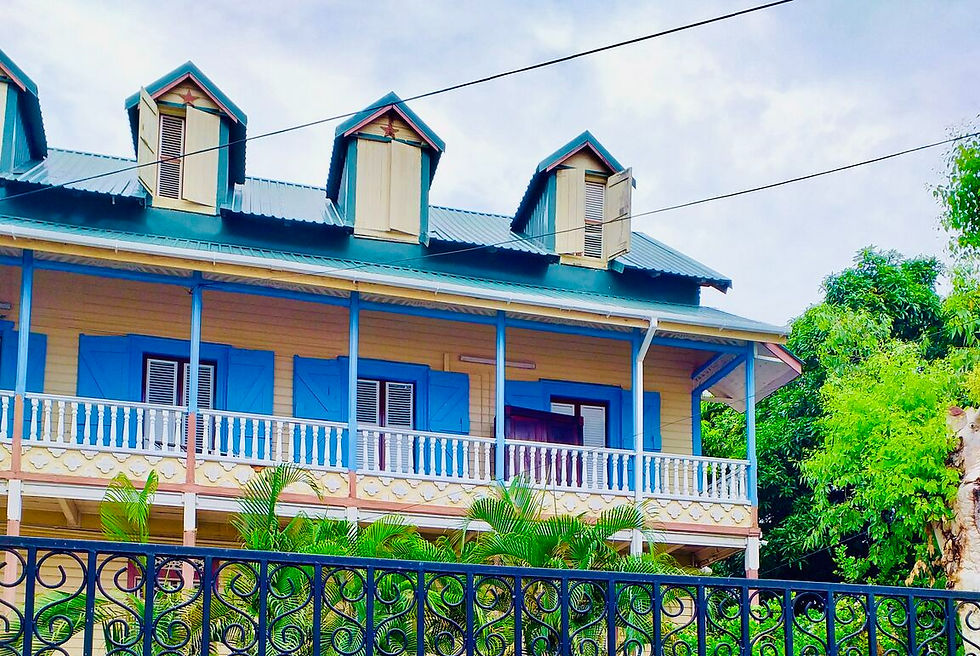
With respect to the architectural changes post revolution: this occurred in the midst of the social and political reconstruction following nine years of vicious warfare, Toussaint L'Ouverture tackled the rebuilding of Haiti's built environment. There was no longer the constricting slave code to build these works, but as he emerged as the leader of Haiti, his ability to effect change was based on the idea of rule by example. His architectural projects introduced the grander elements of architectural refinement as he sought to establish a noble standard of living in the New World. Realising the attitudinal effect created by luxury items in the hostile European environment, he lavished care on the buildings in which he lived. Although they were mostly one room, his palaces displayed the refinement of marble, mahogany, and gold plate. No longer restricted by building codes limiting the cost or scale of a building, these timeless elements blossomed from ideas to functions, as horse-drawn water criers made the labor of bringing water for the hand-hewn mahogany louvered shutters, the flowering jasmine, and climbing bougainvillea possible. Creating the visual evidence of moral and cultural rejuvenation meant producing subtle influences: new attitudes in how people lived. This, in turn, stimulated the use of certain locally grown woods for elaborate ironwork, which in time were adapted to new buildings. Palace ironwork led to umbrella stands, butter coolers, and soap dishes being fabricated in port cities using wire pilfered from warehouses. Few would have thought that sending food to the soldiers would take a building block back to the original natural elements, reverting to their earliest forms of existence. Small elements seem to produce large results. If they did, how could these bastions of design be utilised to control the spread of knowledge and freedom? If they did not, then why would their export be so rigorously controlled? The amazing implications of this layering process resemble the varied architectural strata under the mahogany shutters. Every time a window is opened, the inhabitants look out at a reinforced piece of Haiti's colonial history.
The influence of African and Indigenous art and architecture can be found in Haiti in a variety of architectural elements both pragmatic and decorative.
The African continent's architecture, such as in the Yoruba city of Oyo in Nigeria, the 'maroon' city of Freetown in Sierra Leone, Timbuktu in Mali, and Carthage in Tunisia, incorporated specific spatial and decorative features. While most of the buildings initially constructed in these styles in Haiti were for defensive purposes, the techniques of articulating space—unity, symmetry, and proportion—which were traditionally employed for the construction of private homes—were used. Each villa was designed to contain a walled-in interior garden big enough for the family and its religious objects and for the women to be able to organise daily activities and meetings without coming into public view. The more prosperous the family, the larger the garden would be. This spatial element can also be found in Asian and Spanish colonial Architecture - everything is everything. The preference for individually built structures or an ensemble of small houses facilitated the perpetuation of certain aspects of African and Amerindian lifestyles and religious practices. Collectivity, which was of paramount significance in all pre-enslaved African and Amerindian societies, was difficult to cultivate among the enslaved population in the colonial city or the plantations. The traditional Taïno/African religious respect for open space meant that Nouveau Monde buildings borrowed little from Afro-Catholic rituals, which implied the veneration of or contentions with supernatural beings in enclosed or containing 'separate but interconnected' rooms. However, the Carib/Arawak community center, the barbé or sancoch where food was prepared and collective tasks such as sensory explorations were carried out, was mimicked by the daily outdoor preparation of meat, soups, stews, and medicines from the herb or kitchen gardens and the capsicum and oil tree orchards. Portrait songbirds perched in cages and garden birds often flying free completed the center's ambiance.
Haitian Architecture also danced with European Architectural Styles despite it’s bitter and regretful history.
Haiti, through the growth and development of its cities, evolved from the first successful black slave revolution to an independent, black-ruled nation. During its early national years, the need for substantial buildings transformed the architectural elements of the country. Not only did the masters of the country build European-style homes and civic buildings, but they also created an urban image of themselves that was a reflection of their identity. Key elements of architectural style, including furniture, fashion, and buildings, were imported or emulated. As both the wealthiest members of society and the large exporters and importers, the class established centers of economic trade and culture that distinguished it from its rural counterpart: imported European products and improved housing helped to define the structures as the center of the new society. When the vast city centers were destroyed in moments during yet another struggle for liberation, it was noted that the great palaces and public buildings had for the most part been adorned with columns and wainscoting in marble, paintings of some merit, ornamental stucco work with all the refinements of elegance and luxury that wealth and taste could suggest.
Between the founding of Port-au-Prince in 1749 and the revolution of 1804, various municipal, residential, and garden structures took on European architectural elements. For example, the capitol in Port-au-Prince has several elements common to a European building: a tiered exterior stair, a larger two-tiered verandah overlooking the front of the building, and a portico. This element extends to other public and residential buildings that have a two-tiered verandah and are surrounded by a wrought iron fence. Walls are primarily masonry and stucco with wood beams, floors, and doors. Roof tiles and custom hardware are imported. The geography of Haiti dictated that its principal cities, Port-au-Prince, Cap-Haitien, and Jacmel, were developed as seaports. The cities' battlefield-rich history contributed to the large number of government buildings rebuilt in the similar civic architecture of the time.
Religion plays a key role in Haiti and influences all Haitian art forms.
Architecture, especially religious architecture, reveals this influence. Haiti's religious architecture divides into three distinct traditions or religious groups: Catholic, Protestant, and Vodou. Even though each denomination paints their religion's buildings a different color and each belief builds a distinct type of holy place, each of these buildings serves a purpose beyond religious worship, and all of their services help preserve Haiti's diverse architectural traditions. Haiti's religious buildings, including the holy compounds, chapels, churches, cathedrals, baptisteries, and sanctuaries, also house Haiti's best works of art since most of the truly collectible paintings and sculptures in Haiti hang in or sit in religious buildings. This is an effect of the Haitian population’s sincere and fervent religious beliefs, they openly express their faith. The expressions of this faith covers the walls of Haiti's churches, cathedrals, sanctuaries, and chapels with multicoloured frescoes and murals that depict biblical stories.
Urban Planning and Infrastructure Development
Urban planning primarily involves arranging structures, buildings, utilities, and other connections between them to ensure that an area maintains a prosperous balance of housing, employment facilities, transport arteries, public services, social and occupational facilities, work and rest demands, and a convenient, rigorous pattern. In short, it relates to the nature and quality of life in the area. While Haiti's urban areas are home to probably no larger percentage of the population than in any of the other countries in the Americas, the urban areas in Haiti are vastly different in character from those of all other countries in the hemisphere, whether from a promotional perspective or from a scenic and infrastructural standpoint. The respective differences did not result from any benefits but rather from unplanned evolution and settlement of communities in which resource and income demands were frequently unachievable. However, whether designedly or inadvertently, the largest and oldest Haitian cities are characterised by various subcenters connected by a leading network. Such multiple-centred cities are preferred over the type where development occurs along roads with concentrated frequent traffic. In a specific example, many people have made changes of one type or another to plans for two expressways in local Haiti: as one normally inefficiently stops in various parts of the city, leaving their cars at different levels to return to different homes, fuel, conduct business, etc., without finding transport that achieves any speed higher than walking; for the most part, more than ever, there are ventures on the expressway being created ultimately for the benefit of power and housing designers and structure contractors.
For our conclusion; I’ve drawn three key conclusions from these research sessions. Initially, the architects of Haiti, as the primary figures in the field of architecture, impart distinct qualities to modern structures. Secondly, it has been observed that certain beliefs regarding the perception of architecture are prevalent in Haiti. These beliefs encompass established social structures, historical edifices, and defining characteristics. Thirdly, the architectural landscape of Haiti, a tangible manifestation of the country's historical, sociological, and economic milieu, serves as a representation and embodiment of both Haiti and the architects who shape it. To achieve a satisfactory standard in architectural endeavours within this context, it is imperative to consider not only physical and geographical constraints, but also cultural, formal, philosophical, and ethical parameters, among others. Consequently, it is apparent that architectural production in Haiti is a multifaceted endeavour, posing a challenge to both the discipline and the nation.


Comments