
Vernacular Dialogue: Climatic and Cultural Adaptation in a Soufrière Timber Dwelling
- Alicia Bart
- May 6
- 2 min read


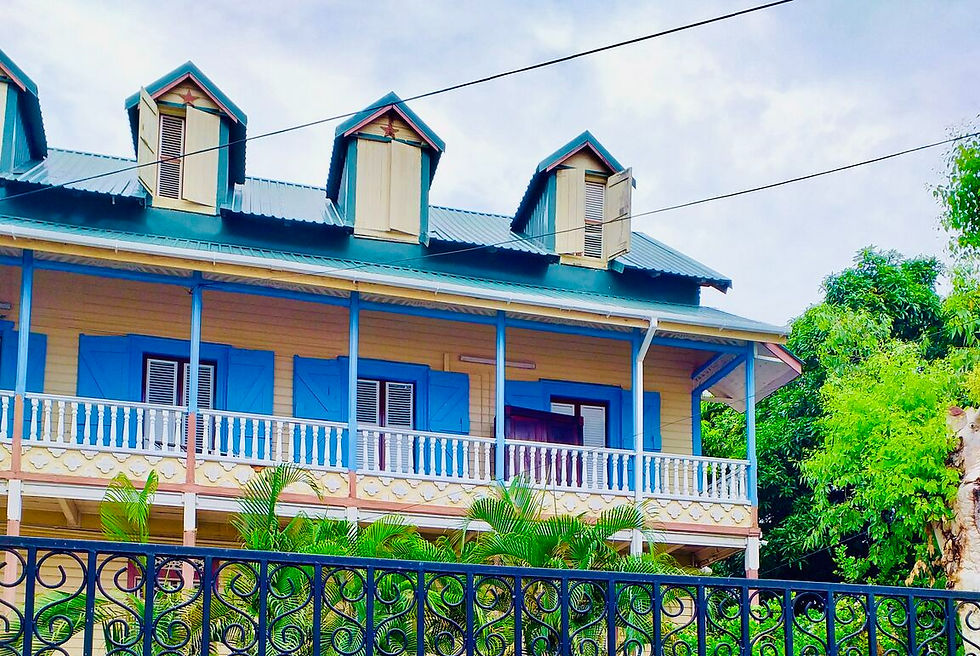
The illustrated building represents a compelling example of Soufrière’s vernacular–colonial domestic architecture, where European influences are carefully adapted to Caribbean environmental and social conditions. Rooted in French and later British colonial traditions, this architectural language is not simply stylistic; it is performative, responding directly to climate, material availability, and patterns of everyday life.
A defining feature of the building is its elevated timber construction. Raised above ground level, the structure demonstrates a pragmatic response to tropical conditions by enabling air circulation beneath the floor, which reduces heat gain and protects against moisture, flooding, and pests such as termites. The application of horizontal timber weatherboarding further supports this environmental strategy. Timber’s lightweight and flexible properties make it well-suited to seismic regions and facilitate both repair and incremental adaptation over time.
The steeply pitched gabled roof constitutes another essential climatic adaptation. In a region characterized by heavy rainfall, this roof form enables rapid water runoff and creates a volume that allows hot air to rise above occupied spaces. Extended eaves shade the façade, thereby reducing solar heat gain and protecting the timber envelope from weathering. Collectively, these features support a passive cooling strategy that reduces dependence on mechanical systems. The upper-level veranda is also a defining element of Caribbean domestic architecture. Serving as a transitional space between interior and exterior, the veranda fulfills both environmental and social functions. It acts as a thermal buffer by shading interior rooms and promoting cross-ventilation. Simultaneously, it facilitates social interaction by providing a vantage point over the street and reinforcing the connection between private domestic life and the public realm. The building’s decorative timber fretwork, evident in the balustrades and brackets, represents a layer of cultural expression integrated within its functional framework. Commonly known as “gingerbread” detailing, this ornamentation filters light and air while highlighting craftsmanship and local identity. Although originating from colonial stylistic influences, these features have been localized and are now integral to the visual language of Caribbean towns such as Soufrière. Fenestration is deliberately designed, with tall, narrow windows positioned to maximize daylight and enhance airflow, reinforcing the building’s reliance on passive environmental strategies. At ground level, the presence of multiple entry points and a more solid base indicates incremental adaptation, potentially accommodating mixed-use functions such as small-scale commercial activity alongside residential use. This flexibility typifies historic Caribbean townhouses, which frequently evolve in response to shifting economic and social demands.
Finally, the building’s compact footprint and direct relationship to the street reflect the broader urban morphology of Soufrière. Influenced by European planning principles, the town is organised around tight street grids and closely spaced buildings, fostering a dense, walkable environment. Within this context, the building contributes to a cohesive streetscape while maintaining its own architectural identity.
In summary, this structure exemplifies a Creole-Caribbean architectural synthesis, where colonial forms are reinterpreted through local expertise and environmental necessity. Each component, from the elevated timber base to the veranda and roof, demonstrates an integrated approach to climate, materials, and social life. The building serves not only as a historical artifact but also as a living model of responsive, place-based design.

Comments